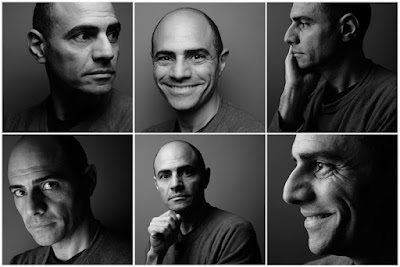
Dan Winters: Brand New Website and F/stop Interview
Travis Smith, Dan Winters' first assistant, emailed me last week to say that the website had been completely revamped. Where there were about 100 photos there are now around 500. Suffice to say this is probably more interesting than whatever you would have been working on in your cubicle for the next few minutes.
It gets better. Winters also gave a very good interview on The F/stop, in case you want a little more in-depth inspiration.
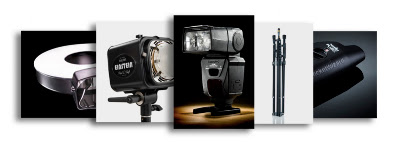
Kelly Mondora started out with FJ Westcott as a temp in data entry 12 years ago. Now she's VP of the entire photography industry division.
Why? Because of stuff like what you see above.
Our go-to umbrella, the Westcott Double-Fold, is now crush-proof on the business end of the telescoping staff. A little backstory, a DIY workaround and a cool coupon code, inside. __________
In March of last year, I went to PMA as a speaker and to check out some of the new toys. That's where I met Kelly, who has that rare combo of really caring about her customers at a ground level and being high enough in the company to do something about it.
We talked the near-perfect Westcott Double-Fold, and she quickly honed in on the "near" part. Small, light, cheap -- but crushable if you tighten down on the shaft with your umbrella swivel.
There was even a DIY hack, as seen above, where we shove a pencil up the shaft (New! Graphite Shaft Edition!) to support it.
She told me then and there that they could fix it, and now they have. Redesigned, solid-shaft tip versions are trickling up through the supply chain as we speak. Awesome.
If you get an hollow version (or want to strengthen your current umbrellas) the pencil trick works great. But soon, you won't have to.
And for those who say, "why not a solid shaft," please bite your tongue.
For one, they are heavier. For two, they have to screw apart. And trust me, you do not want extra loose parts which love to drop and roll under your car when you take an umbrella out of your trunk. Been there. __________
Coupon Code
This weekend, Westcott is kicking off a "Top Pro Tour" roadshow. (If you haven't, heard about it, info is here.)
Kelly sent us a coupon code (as if the solid shaft wasn't enough) in case anyone wants to head out. It's $89.90, but entering the code TPT4949 gets you $20 off.More>>
Planning ahead is a good thing, and I always try to pre-think a job before I head out. It gives me ideas to fall back on if nothing jumps out at me at the location.
But you can pre-plan things too far. So much that they blind you to better ideas and leave you banging your head against the front windshield even as you drive away from the assignment.
That's exactly what happened to me last week when I was assigned to shoot one of the coolest pieces of tech I have ever seen. __________
You are looking at a real, prosthetic limb in the photo above. But not just any prosthetic limb, as this limb has quite a bit of special sauce.
For one thing, much like your own mostly-dark-meat arm it can move in 22 different ways -- brushless motors everywhere. It has a ton of processing power inside the hand. Not a lot of space there, but you want the thing to be modular with the smarts at the end. That means you can attach it to partial limbs.
Much like Popeye, this thing has its power in the forearm. That is where the user-replaceable, rechargeable battery is. And it has power to burn. It can curl 50 lbs. That's more than my arm will do.
Oh, and did I mention it is designed to be controlled by the human brain? Just like in Firefox, where Clint Eastwood has to think in Russian to fly the advanced fighter jet he just stole. It gets impulses from the brain and provides neural feedback so your brain kinda knows what is going on with it.
My first thought when I saw it: Where is the rest of the cyborg it was attached to, and where do you have to shoot it to kill it. (People always aim for the head in the movies, but this thing has its brain in the hand. So it pays to ask.)
The folks at the Johns Hopkins Applied Physics Lab hate it when people write stuff like that, because they really are not trying to hatch a T-virus. (Of course, that's also what SkyNet said.) They just want to give high-level function back to people who have lost a limb.
And they are doing it, too. Live, clinical trials within a year with these things, thanks to a $34 million dollar DARPA grant. Sorry, Steve Austin. $6MM doesn't really cut it anymore.
So you can probably already tell how stoked I was when I got the assignment to shoot this thing for a local biz pub. And the fanboy stuff only got worse when I got to the lab.
Fortunately, I knew exactly what I wanted to do -- all planned in advance. I had a cool idea for a portrait of Mike McLoughlin, the head of the Modular Prosthetic Limb project. And I also wanted to get a sexy product shot of the arm itself.
For a variety of reasons, the portrait I visualized wasn't coming together. So I did the photo above which was perfectly serviceable for the assignment, but not what I had hoped. Then I circled the wagons and worked the product shot to salvage at least one of my preconceptions. __________
The lighting was pretty simple -- on axis light with an Orbis and four SB-800s spread around the floor to create highlights along the edges. On the clock face, the wrap lights were about at 2:00, 5:00, 8:00 and 11:00. Power levels were all about the same by the time the lights hit the arm. (I cranked up the Orbis a little to compensate for the light loss.)
Except for the Orbis, everything was hard light. This gave me a lot of shape and highlights. The Orbis mostly erased the shadows and makes the whole thing look strangely soft.
In the setup shot above, you can see the distances involved. You cannot see all of the flashes, but the highlights on the floor will point you to them. Dave Kile (who was helping me) piggy-backed my flashes with a channel-1 PW as I pulled the ring away between shots. (I was shooting through the ring for the actual shot.)
Background was a cheap poster board, in a complementary color. I'll usually bring three or four different colors if I am gonna do a small product shot. Way easier/cheaper than background paper. __________
While I was on location, I was thinking that the portrait I wanted which did not happen. But at least I got the product shot I visualized. It wasn't until I got back to the car and was reviewing photos until the photo I missed hit me.
The portrait I wanted would have been cool. But the iconic picture was right behind my subject the whole time.
I should have shot a still life at the workbench.
You know, just like any other DIY hacker's work area -- soldering iron, pliers, a smattering of little parts and a couple cyborg limbs that mark an amazing leap in bio-mechanical science just sitting around. Static, but a great narrative.
I am such an idiot for missing it.
Of course, I even fawned over the workbench while I was there. But I was so blinded by the pictures already in my head (especially 'cause one of them was giving me fits) that I did not see it.
Pre-planning is not a terrible thing, and I am not ready to give it up. But you can bet I will be on guard for awhile against stupidly missing found pictures because too much thought is being given over to the preconceptions. __________
Any time Gregory Heisler gives one of his iconic photos the BTS treatment we pretty much pre-empt the regular programming and turn the joint over to him. And his photo of NYC mayor Rudy Giuliani for the 2001 Time Magazine Person of the Year cover certainly qualifies.
I love this photo, and actually carry it around on my iPhone in my inspiration folder.
Before you make the jump to the very cool video inside, take a moment to reverse what he did with the lighting. And more important, why he did what he did... __________
I love how the environment drives the lighting in this photo. Every full-strength light comes from below, because that is where the ambient is coming from. Every full-strength light (key or otherwise) is green, because that's what color the lights in the buildings were at dusk.
It is only the fill that is soft and comes from up top, and that light gets a warming gel. So there is not a single white light in the bunch, and only the fill is coming from a traditional key light position.
I love the way he deals with problems -- most notably, whether or not his subject stand on the edge of a skyscraper. He mentioned in the video that it started to rain, but what he didn't say was that he only got off a few frames before it was all over. (I wanna say four, but it has been a long time since I heard him talk about this one and I cannot remember for sure.)
How's that for a pucker factor? Especially with no digital screen on the back of his 8x10.
And speaking of 8x10, there are some unmentioned camera movements involved, too. Check the focus on the Empire State Building as opposed to the background buildings on the right.
Major props to the folks at Profoto USA for doing this series. we'll gladly sit through your soft sell in exchange for this kind of info. Pass the popcorn and keep 'em coming. __________
Yongnuo "John Snow" ST-E2 Punches Above Its Weight
For those of you who are Canon shooters and use optical remote flash, you may want to look at Yongnuo's version of the ST-E2 transmitter.
Highlights:
• AA-powered (no more 2CR5s!) • Greater range -- like, a lot • Swivels 135 degrees • Thus, can control flashes behind the camera • About half the price (est. street, China)
So what's the deal with the "John Snow" part? That's how Google machine-translates the name on the detailed review on our Chinese language partner site. So, John Snow it is.
Okay, Canon shooters, is this thing interesting enough to take a flyer? What about you current ST-E2 owners -- are the extra features enough to make you reach for you wallets?
UPDATE: Adds available-light-only version of the photo, inside. __________
New York based photographer Nathaniel Welch shot the above photo to illustrate a story for Men's Journal on the flaws of sunscreen. I thought it really popped, and talked to him about the lighting while he was en route to Boulder Colorado.
__________
Welch lit his subject with three Profoto 7B's, each in a white beauty dish which he prefers to the silver version. One was used as a key light directly in front up high, with the other two as rims on each side in back.
"Sometimes I like a silver in front," he says, but generally prefers the light quality of the white ones. He will occasionally remove the disc that blocks direct light in the dish (which he did for this shot) noting that it changes the quality of the light and gives him an extra stop of output.
UPDATE: Here it is, without the strobes. Ambient exposure is based on the sky, and the sun is pretty much a non-issue for the subject:
__________
"The brief was fairly tight to be honest," Welch said, noting that is normal for a cover but not so much for inside photos. "This was one of the most directed editorial shoots I have had in a while. There was even a photo editor onsite."
He shot looser versions, which he preferred as it showed more of the subject's skin. But in the end end the magazine chose the tighter image and ran it almost full page.
"In the original, the reflection in the sunglasses was too dark," Welch said. So for this shot, he placed the sun behind the subject and lit him entirely with flash. The front beauty dish key light was angled to mimic the light of the sun, then they shot the sun separately and stripped it into the glasses.
Welch usually seeks to use minimal retouching, and has a very good blog post on the subject, if you are interested in that kind of thing. Actually, his whole blog is quite good and very much worth a spot in your RSS reader.
As for the platform, Welch uses a Canon 5D Mk II, which severely limits his sync speed. The 1/200th sync is tough enough. But like many Mk II's, he has to open his up to a 1/160th to get a full sync with no dark stripes encroaching on the bottom.
"It sucks. It really sucks," said Welch of the sync speed.
True. And the net result is that low sync speed forces him to bring more flash power to make up for the higher resulting apertures when balancing outdoors in full sun. __________
(If you cannot see the video above in your email or RSS feed, click here.)
To get a sense of who Nathaniel Welch is, check out his Redux interview/portfolio video above. And you can see more of Welch's work (definitely worth a look) on his site.More>>
Quite a few people asked me about the small boom that was used for the key light in the photos of J.D. Roth.
Here's the skinny, in seven words: Cheap, travels well; I really like it.
Details, after the jump. __________
Okay, here's he thing: It is not a boom at all. It's a reflector holder:
That said, it is a pretty slick little boom for speedlight folks. But officially, it is the LumoPro LP621 Reflector Holder, and it is $45. (But until the end of the August, there is an instant rebate that takes it down to $40.)
Note that the stand also shown above does not come with the boom -- you get the swivel head and the boom itself. It comes with the clamps to hold a reflector, which I will probably never ask it to do. So I pulled them off.
Here's why I like it as a boom. It extends to 66", but collapses to 30" for easy travel. The swivel head is ratcheted, which means it punches above its weight. It'll hold more than you'd expect.
Further, it has a stud on each end so in addition to hanging your speedlight out there (firmly) on one end, you can hang a counterweight on the other end with the included hook. I like to use a 2.5-lb free weight disc, which you can barely see at right.
One caveat: I do not recommend balancing this thing on top of a compact, 5-way stand. While I love them for speedlights, this would be asking too much of the stand. (The boom is sturdy, the compact stand combo is not.)
So you'll want to stick it onto just about any other standard-sized light stand and everything's cool. Remember to slide the boom on the fulcrum until your weight easily balances your flash naturally before locking down the clamp.
For good measure, I hand a camera bag on the stand itself, too.
But all-in-all, a very wallet-friendly solution for an over-the-top problem. __________
Terminally bored and trapped in your cubicle this afternoon?
Ibarionex Perello and I were finally able to mesh our schedules to do a podcast interview for The Candid Frame. It's 45 mins, and covers Strobist's early days, leaving the paper and what's next.
While I was in Portland last month I photographed J.D. Roth, the man behind the blog Get Rich Slowly, for my ongoing project on bloggers.
J.D. had earlier escaped the shackles of a big wad of credit card debt, and has since created a career out of teaching others how to manage their money more sensibly. For the shoot, we did some standard headshots which would be useful to him for his public speaking appearances, etc. But I also wanted to do something a little more intense and/or cerebral, which is what led to the shot above. __________
If the ambient was decent, I could've done this with one speedlight. But as it happened, the ambient in the room was pretty low so we used three flashes. The first step, as in the Betty Allison shoot, was to kill the ambient. This one would be lit completely with flash.
Betty's shoot is actually a pretty appropriate example, now that I think about it. The lighting setup is pretty similar, even if the look is very different. Once I killed the ambient, I started from the back with a domed SB-800 against the wall. This gave me a very controllable gradient on the background.
Next, came the on-axis fill -- in this case an Orbis w/SB-800. The exposure on this flash was sufficient to light J.D. to the level you see on the far camera right side of his face. It's a little deeper than normal at almost 3 stops down.
The key light, coming from close-in high camera left, was another '800 in a LumiQuest SB-III. But as you can see the light is not wrapping around on the camera-left side of J.D.'s face. That's because I partially gobo'd it with a piece of cardboard clamped to a light stand between the key light and J.D.
This is why he looks like he is emerging into an interesting shaft of light. Because that is exactly what he is doing, only it is a static setup. You tend to see this light in real life a lot more than you might think, only it is usually very brief when it happens.
I still did not quite like it, as his forehead was a little hot. Luckily, the cardboard envelope I was using as a gobo also happened to be my gel kit. So I took a 2-stop ND gel (sized for my studio flashes) out and further cut down the light as it was traveling up the upper camera left side of his forehead.
That gave me the look I wanted -- something more interesting than the standard umbrella headshot. Depending on where / how it will be used, one may be more appropriate than the other. But it is nice to have both. __________
For a second look we did something a little more pulled back -- and with a little more content, too.
As you might guess from the name of the blog, J.D. espouses the theory that slow and steady wins the race. So my idea was to get him rolling coins at the dining room table.
And it wasn't much of a stretch, as he of course had jars full of saved pennies and other coins.
Again, I am looking for light that is not the standard umbrella/softbox stuff. Where possible, I like to have light that is both motivated and interesting -- but also something I can control.
So I used a normal light stand and a mini-boom to light him from overhead (just in front) with the Lumy SB-III. It had an "overhead lamp" kind of look, which was appropriate for a dining room table. Fill was with (surprise) an Orbis ring at about two stops down.
That retained the shape of the overhead light, but gave some legibility into the shadows.
Here it is without the fill, and you can see how much the ring light is really doing -- without calling attention to itself. There's a little ring signature shadow on the wall, but I am okay with it. Would been easy to kill by moving everything a few feet away from the wall and sticking a flash in there to light the wall only to it's natural level from the key. That would kill the shadows without adding anything.
Start a Project
I am really enjoying the shooting the blogger project, for a number of reasons. Committed bloggers are very interesting people for me to meet. The shoots are cool, but even better is the conversations that happen around them. We tend to work alone, in our respective caves, and it is a cool thing to connect with like-minded people. J.D. and I exchanged good ideas all day long. Not to mention his wife Kris's praline upside down cupcakes...
If you have a camera, some enthusiasm and just enough knowledge to be dangerous, I highly recommend embarking on a personal project of your own. The bloggers are really a side project for me at this point, but I do have something more significant that I am working on.
A little thought (more like 3 years worth, for me) goes a long way. And my hope is to get some of you thinking in terms of a sustainable project of your own. After all, what is the point of growing your skills as a photographer if you don't do something fun and worthwhile with it?
And if you'd rather get rich instead, you would do very well to start with J.D.'s blog.More>>
Why endure yet another "strategic planning session" at work when you can secretly be shooting away in your studio instead?
Remember to nod your head occasionally, and make eye contact with the speaker every few minutes as you appear to be inputting important notes from the meeting on your iPhone. Trust me, they don't want to be there any more than you do. They'll never notice.
Oh, and for the record: I know this is a capabilities video, but that is way too damn many light sources for shooting a bendy stick figure. __________
I just got back from perhaps the darkest place I have ever been. We were twenty miles form the nearest city of any size, at over 8,000 feet of elevation with no humidity on a moonless night. That's a straight shot of the night sky, above.
I was on a family trip to a dude, er, guest ranch after teaching in Denver two weeks ago. So I had a better-than-average collection of gear with me for being on vacation. But only one problem -- no tripod. __________
Duuuuude!
Those of you who know me also that a dude ranch is about the last place you would ever expect to find me. As in, I don't ride horses. We had 'em when I was growing up. I always found them to have a distinct lack of hard controls, most notably any type of reliable braking mechanism whatsoever.
In fact, my last significant interaction with a horse was actually more of the gastronomic variety. This was thanks to my friend Fons at CERN. So my daughter Emily and I do share a love for horses, even if not the same kind of love.
The Long Con
Speaking of Em, that's her above, riding on the open range near Red Feather Lakes in Colorado. Her mom let her go without a helmet just this once so I could grab a panned shot of her on her horse-for-a-week, Oreo. (The name, of course, only strengthens the gourmet equine connotations in my mind.)
She's entering 7th grade this year, but was in 4th grade when she hatched the scheme that would end up in our spending a week at the Sundance Trail Guest Ranch in northern Colorado.
Her assignment, courtesy teacher Kim Eubanks, was to research and report on what would be her dream vacation -- anywhere in the world. With no limits, all of the other kids chose foreign and/or exotic locations. But Em researched and fell in love with a small, family-oriented guest ranch about two hours north of Denver.
It was a very sweet thought, but these types of places are not our normal modest-price hotel fare. Still, Susan and I both admitted that it might be possible with a little frugality and a lot of saving.
So later when we announced to Em that we would, in fact, be heading to Sundance Trail, she told us that had been her secret plan all along. In other words, we had just been expertly played by an 8-year-old for a four-digit payoff.
Oh, and as a bonus the place was just crawling with kittens. For Em it was pretty much like that lab experiment where they give the rats all of the crack they want, just to see what happens.
My wife Susan is a rider, too. So there was no question she was gonna have fun. But Ben and I are not horse people, so we spent the week doing lots of other stuff. Between the white-water rafting, climbing, tomahawk throwing, campfires, hiking and (especially) shooting, we had a great time.
Oh, and don't even ask me about the food. Suffice to say that Nate took good care of us in the kitchen, even if Trigger was not on the menu. And Susan and I both lost a pound each. Go figure.
In Need of Support
By the second night I was totally infatuated with the dark skies, which featured layers upon layers of stars. There were so many that I could not easily find the major constellations, and the bands of the Milky Way were gorgeous. This is not something we often see in the east, so I was like a kid in a candy store.
But I had left my tripod at home, and none of the other guests had one I could mooch. So I started to experiment with various DIY substitutions to keep the camera still for the ten seconds of so I could use before the star trails would start to be obvious from the earth's rotation. I pined for my tripod and John Moran's brilliant DIY astronomical camera mount. Next time, I'll bring both.
In the end, the porch rail and a rubberized iPhone (used as an elevation shim) served the purpose pretty well -- even if it did limit my shooting direction. Using the self timer to allow the camera to settle down, I was able to get a pretty sharp 10-second exposure at f/1.8 at ISO 3200. The 35/1.8 lens (fastest I had with me) was designed for small chips, thus the vignetting. But I kinda like it, to tell the truth.
Flashes and Stars
Shortly after, I started thinking about a shot of the lodge lit against a backdrop of that stunning night sky. And it didn't help that I had half a dozen SB-800s with me, along with stands, PWs, etc.
I know -- I'm on vacation. But still, I really love playing around like this. And on vacation you should get to do anything you want, right?
So I chose a fence post for a camera support and set off to light the lodge to f/1.8 at ISO 3200 with speedlights. I could easily light something a couple of football fields away at that level with speedlights, after all.
I set up my key light about 200 feet away (for even lighting) from the lodge at dusk. Then I set a fill light right in front of the front porch, hidden by an old wagon in the front yard. A little guide number guestimation showed me that I would not even have to crank up the flashes to full power to light the house from this distance.
As the ambient light dropped down, I did test shots of the lodge against the sky. Visions of a gorgeous shot of the lodge and the night sky danced in my head. Maybe I would even get lucky with a Perseid meteor or two in the frame.
But then something unexpected started to happen. Long before the stars started to appear, the lodge itself started to go nuclear bright. I had not considered what a normal, interior light (60th @f/2.8 @ISO 400) might look like at f/1.8 at 10 seconds at ISO 3200. Little hint -- they are very bright at that exposure.
As in about 13 1/2 stops over.
(Apparently, my brain takes vacations, too...)
Even by shooting RAW files and combining single images imported at multiple exposure levels, I quickly knew I was not going to be able to marry the two exposures -- small flashes or not. Well, okay, I could. But that would mean turning off all of the interior lights and triggering tiny flash pops in each room -- for each exposure.
Nope, this was where I would cut my losses and bail in favor of the campfire and songs that had been my backdrop for the shoot until now. After all, I was on vacation.
The fickle weather in the Colorado highlands teased with other short-lived opportunities to do a lodge-and-stars shot. But instead I decided to go with the flow, shooting the transitions that included both moving clouds and star fields. I had never seen anything like it before, and might never again.
The firey colors on the horizon are from the city lights that the locals lament are ruining their rural night views (they're looking at you, Ft. Collins…) But I thought they made a neat separation light for the mountain trees on the horizon. So you are fine for now, Ft. Collins. But no more development, please.
For those interested in a week in the saddle, I cannot recommend Sundance Trail enough. Definitely check it out.
Even as a non-rider I had one of the best weeks of my life. And the horse people in the bunch wore big smiles (along with sore butts) all week long, continually exploring some of the most beautiful backcountry you could ever want to see.
If you visit Sundance please give Dan, Ellen and the gang our best. And be sure to check out the family brand we charred into into the dining room wall before leaving your own.
Oh, and bring a tripod. Unlike me, you might have the patience to get all of the lights turned off for a flashed, lodge-and-stars photo. If you nail it, please post a link in the comments below this post. I'd love to see it.
UPDATE: The flash is en route back to China and a second copy will be in my hands ... in an undetermained amount of time. Will report back then. __________
After months of rumor-fueled anticipation, I finally got my grubby little hands on a production model YN-560 speedlight.
The new, $85(!) flash has two important features which potentially potentially make it an good addition to a lighting photographer's bag: A built-in slave and an external sync jack.
Any shoe-mount flash with that kind of bling deserves a look.
First impressions, after the jump. __________
The flash I ordered was a standard production unit. I had seen reports around the web from pre-production versions, but this review is from a unit purchased directly from Yongnuo via the US eBay site.
There are lots of different people selling them on eBay. But Yongnuo was offering a one-year warranty, which made them the obvious choice. Your mileage may vary with other retailers, who may offer a warranty anywhere from one year down to nothing.
There has been a lot of talk of the YN-560 as a lower-priced alternative to the $160 LumoPro LP160. Let's see how it stacks up.
Build Quality / Warranty
Yongnuo is an up-and-comer. Their quality continues to improve, and I have been very happy with my Yongnuo 10m TTL cord. Similarly, this flash gets triple aces on build quality -- it is very solid. Like, surprisingly so.
It feels like a much more expensive flash, aping the lines of the similarly named Canon EX-580 II. The battery door is captive and hinged (a plus over the LP160) and very well-designed. The battery polarity sticker is a nice touch for guys like me who are putting off getting bifocals. (That bell tolls for me in three weeks -- I am officially old.)
The batts themselves drop right in, whereas the LP160 housing can be a little tight on some of the rechargeable batts that sometimes are a little bigger than the alkaline versions.
The PC jack and high-voltage jack (don't get too excited about the latter yet) are covered by a rubber door -- another nice touch. Unlike the metal foot on the LP160, Yongnuo chose to use a plastic foot on the '560. I would not consider this a problem, as it appears to be solid.
Like the '160, it has a screw-down lock collar, but also adds a lock pin. In practice, the screw-down collar should suffice. Short answer, both models have reliable feet.
Weight-wise, it measures up about the same as an LP160 -- maybe even a tad heavier, judging with one in each hand. Both of these models are well-built.
So, build quality is great. Which is not to say that quality control necessarily is on the '560. As I said, this was a production model. But nonetheless, mine had some problems.
The recycle beep function did not work on my flash, which is a minor annoyance from an otherwise helpful feature. The LP 160 does not include a ready beep, but does include a ready light on both the front and the back. Call it a wash -- well, if the ready beep worked on the '560.
Far more frustrating was the fact that my flash had a non-working zoom-head motor.
Argh.
I so wanted to love you, YN-560. Now you hit me with a second, non-working feature. The absence of which essentially makes the flash unusable for me, necessitating a round-trip return to China.
On the one hand, this is why I strongly suggest buying direct. On the other hand, I would also suggest that Yongnuo join LumoPro in hand-checking each unit before it goes out. It is only a wasted effort if your quality control is hitting 100%. And you are not there yet, Yongnuo.
It's 30 seconds of prevention to insure against a few weeks' wait for the customer if problems arise later. Especially until Yongnuo gets the early production bugs worked out.
Slave and Sync
Kudos to Yongnuo for including both a slave and an external sync jack, although I would have loved to see a 1/8" jack alongside the PC version. Having to buy overpriced PC cords over the life of the flash is a hidden tax when compared to flashes that sync with a 1/8" jack. Advantage: LP160.
From my early testing, the slave appears to be very capable, and on par with that of the LP160. I would have liked to see more rotation on the flash head, which goes 180-left and 90-right. This leaves one quadrant uncovered for times when you need to point the flash head one way and the slave another.
The LP160 goes 180-right and 150-left, meaning click stops every 30 degrees around the circle. This difference will not seem important to you until you need to point the slave in a certain direction to get a good sync. Advantage, LP160.
Control Interface
What can I say. I found the 560's controls to be both fantastic and maddening.
On the plus side, you get a 1/1 - 1/128 power range. This is unheard of in the sub-$100 price range, but they go and include eight steps of variability between each stop. Amazing in theory, but in practice the flash's consistency tops out in the ~1/3-stop range. In other words, it ain't a Profoto D1, but I really like where they are aiming. You have to give them major props for that little trick. Advantage: YN-560.
That was the spoonful of sugar. Now here's the medicine.
The flash uses a row of 8 LEDs across the back display to give the following info:
1. Zoom head angle: This is the only function that is actually labelled, and a tad ironically so for me given that my zoom motor did not work.
2. Power range, from 1/1 to 1/128: When adjusting the power with the left/right buttons, the dot scale represents overall flash power -- but is not labelled as such. You have to count the dots. That's a dumb miss -- what were they thinking?
3. Intra-stop power range: When using the up/down buttons, this adjusts the power between stops. Again, no labels, and going for the third indicator from the same set of LEDs gets problematic when it comes to labeling.
I applaud the effort to get as much mileage as possible out of the LEDs, but I personally found the interface to be completely non-intuitive bordering on pretty annoying.
On the other hand, the LP160 has two rows of LEDs signaling both zoom head setting and power setting. So, while the LP160 lacks intra-stop adjustments and a 1/128th power setting, I still strongly prefer its interface -- faster and more intuitive.
Modes
Both flashes feature manual mode and two slave modes -- straight and pre-flash. They are pretty self-explanatory, although I do not know exactly how each handles the pre-flashes. But there is some mechanism for adding slaved manual flash to your TTL flashes, if that is your thing.
The YN560 offers a power saving mode, which will idle the flash after 3 mins. The instruction manual says you can wake it back up from its slumber by pressing the test button or the power button. Presumably, the test circuit could also be activated by a hard trigger at the PC jack, but probably not via the slave. After 15 mins of being dormant, the flash will turn itself off. If you are in either slave mode, the flash will extend the dormancy period to 30 mins.
That's pretty cool, but here's where it goes off the rails. If you turn off the power-saving mode, the flash will still shut down after 30 mins of non-firing (60 mins in slave modes).
Maybe it is just me, but if I turn off the power-saving mode, I would want the flash not to go to sleep. So if you pre-set flashes before an event, you'd better remember to pop them occasionally while you wait for the event to start. This is just dumb programming, and I would strongly suggest changing this on the next product run.
If I am not in power-saving mode, it is because I want the flash to stay on. If I drain the batts, it's on me.
Power
Other testers have reported power levels to be similar to the Nikon and Canon flagship flashes. Just a tad below, to be specific, for both the '560 and the '160 -- and I have no reason to doubt them. In short, plenty of power.
I'd confirm it, but I do not even know what zoom setting my flash is stuck at. It's something wide as far as I can tell. Barring that info, comparative readings would be useless.
Recycle Time
Nice surprise here -- the YN-560 recycles fast. As in less than 2 seconds for NiMH's, and ~4 secs for alkalines. Remember, 1.2 NiMH batts deliver current faster than their higher-voltage alkaline cousins, and that's what counts.
But with great power comes great responsibility, dragonfly. After just ten full-power pops at the speed at which the internal NiMH AA's will recycle it, the '560 will drop into thermal protection mode for several minutes.
So back off, Rambo, unless you want a three-minute time-out. My advice would be to back off the recycle time just a tad so we could make use of it for more than ten pops at a time. Or, add in a little better heat sink and let us make use of this fast cycling.
Oddly (given the above) the YN-560 includes a high-power jack which appears to be a Canon model jack. Why would you do this on a flash that can overheat itself in ten full-power pops using just NiMH AA's?
This I do not know. If you get a YN-560, my advice is to ignore the hi-power batts. The inability of this flash to quickly dissipate heat would make it not very useful.
Accessories
Unlike the LP160, the '560 does not come with a sync cord, but it does come with a case. Both flashes come with a foot/stand, and the '560's has a metal 1/4x20 insert. Nice.
And, oddly, my '560 came with a Sto-Fen -type dome, but it was outside the box. So I do not know if every YN-560 comes with a dome, or if I was just lucky. Add in the variable of other dealers, and who knows.
There is a pull-up/fold-over wide-angle panel, and a pull-out bounce card -- nice. The panel is pretty stiff, and without a lot of lip to grab. If you are a fingernail biter, you'll probably have to pull out a credit card or driver's license to get it out. But still, nice touch. The LP-160 has a slip-on diffuser panel. No nails needed, but you could lose it.
Advantage: Depends on what accessories are more important to you.
Where to Buy
No brainer -- get it direct from the factory on eBay. Why? Well, there's the one-year warranty for starters. It's not as long as the LP160 (2 years) but still very good. Alas, if you have problems with it as I did, it will require a round-trip back to China. But at least there should be no passing the buck on who is to blame for the problem.
And don't be confused by the Nikon version vs. the Canon version vs. the Pentax version, etc., on eBay. As far as I can tell, they are all the same. Just keywording to try to catch more bidders.
So that's the quick test drive. If you are using a YN-560, hit us in the comments with your experiences.More>>